Your next computer will cost more. Here’s why.
CAPITALS INSIDERS Markets, made simple — Evening edition · Friday, October 30, 2026 | |
Good evening. This morning we wrote about how much cash the big technology companies are pouring into AI data centers. Tonight, a side effect you may feel at the store: those data centers are buying up so many memory chips that ordinary computers are getting more expensive. Intel's results made it impossible to ignore. | |
🌙 Evening Desk Why your next computer will cost more  Start with Intel. The chipmaker's shares fell about 25% before the open after it gave a fourth-quarter forecast below expectations. Chief executive Lip-Bu Tan explained the reason plainly: "Our customers began signaling a PC slowdown based on the memory prices and availability." In other words, computer makers are building fewer machines because one key part has become scarce and expensive. The mechanism starts in AI data centers. The advanced memory that AI chips need is made on the same factory lines as the ordinary memory in laptops and desktops. The three big producers, Samsung, SK Hynix and Micron, have reportedly sold out this year's supply of the AI version, leaving less for everything else. Research firm TrendForce estimates that contract prices for mainstream memory rose 13% to 18% in the third quarter alone and will rise another 10% to 15% this quarter.
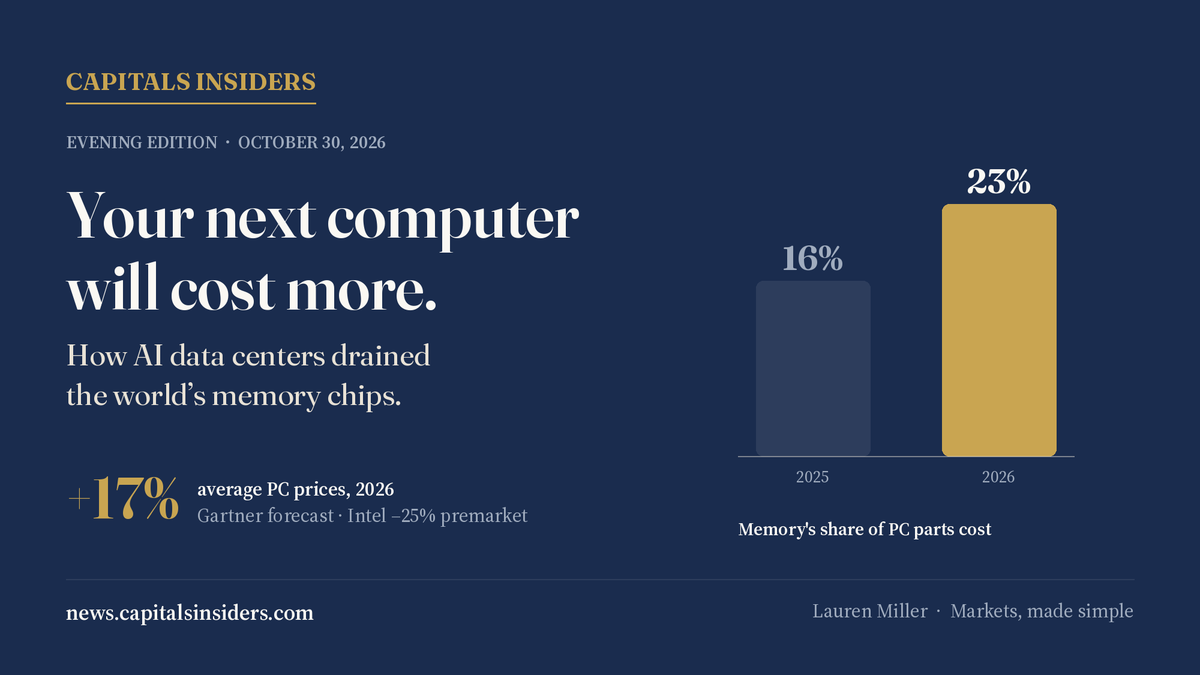
That cost lands on the price tag. Gartner forecast earlier this year that average PC prices would rise 17% in 2026 and that memory would make up 23% of a computer's parts cost, up from 16%. Acer's chairman, Jason Chen, expects store prices to rise another 5% to 20% this quarter depending on the model, and to peak around the middle of 2027. Buyers are responding by waiting: IDC counted 62.7 million PCs shipped worldwide in the third quarter, down 20.1% from a year earlier. The industry is improvising. Some computer makers are going back to older, cheaper memory standards that AI data centers do not compete for, and motherboard maker Gigabyte said this month that boards built for the older DDR4 memory will support new processors due early next year. The gap is striking at retail: The Verge found a 32-gigabyte kit of the newer DDR5 memory selling for $620, against $260 for a comparable DDR4 kit. Intel itself launched a stripped-down chip for entry-level laptops starting at $599. For investors, this is a clear example of how the AI boom creates winners and losers outside the obvious names. Memory makers are thriving; Sandisk just announced a stock split after strong results. Companies that sell finished computers, and the chipmakers that depend on them, are being squeezed. For households, the practical point is simpler: if you need a new computer or phone, expect to pay more than last year, and expect less memory for the money at the lower price points. | |
📈 By the Numbers Intel Down about 25% before the open on a weak fourth-quarter forecast. Memory contract prices +13% to 18% in Q3; +10% to 15% expected in Q4 (TrendForce). Average PC prices Forecast +17% in 2026 versus 2025 (Gartner). PC shipments, Q3 62.7 million, down 20.1% from a year earlier (IDC). Price peak Around mid-2027, according to Acer's chairman. Retail memory 32GB of DDR5 at $620 vs. $260 for DDR4 (The Verge). Coming up: midterm elections on Tuesday, November 3; the Fed's next decision on December 9. | |
📜 Wisdom of the Street “The cure for high prices is high prices.” — Commodity traders' saying Memory makers are adding capacity, and buyers are waiting. Both are how this shortage will eventually end. | |
Have a good weekend. — Lauren Miller, Capitals Insiders |