Who pays for the AI boom? Check your electric bill
CAPITALS INSIDERS Markets, made simple — Evening edition · Monday, November 9, 2026 | |
Good evening. Today we covered jobs this morning and Berkshire at midday. Tonight, a question that will land in your mailbox this winter: why electricity bills keep rising, and how the AI data center boom and last week's election are now tied to that bill. | |
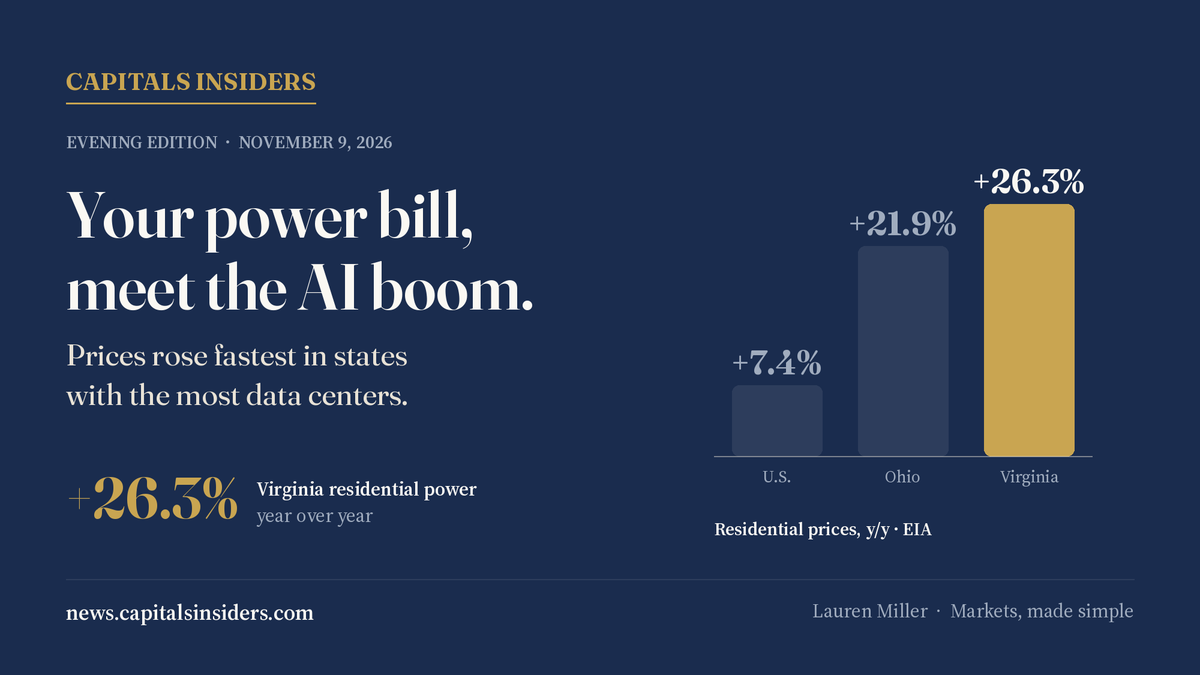
🌙 Evening Desk Your electric bill is now part of the AI debate  Start with the bill. The average U.S. residential electricity price reached 17.65 cents per kilowatt-hour in February, up 7.4% from a year earlier, according to the Energy Information Administration. The increases were steepest in states with the most data center construction: Virginia, home to the largest cluster in the country, saw prices rise 26.3%, and Ohio 21.9%. The mechanism is mostly the grid, not the power itself. Utilities are spending heavily on new transmission lines, substations and distribution equipment, and those costs are spread across every customer's bill. Data centers, manufacturing and the shift to electric heating and vehicles have pushed electricity demand growth to about 2.1% a year, roughly double its earlier pace. Natural gas, which generates 43% of U.S. power, has also cost more.
Washington has tried once already. The Ratepayer Protection Act, which would have required state regulators to consider making data centers and other large users pay for the grid built to serve them, passed the House 417 to 3 in September. It failed in the Senate on September 30 with 57 votes, short of the 60 needed. Senate Minority Leader Chuck Schumer called it "toothless" and said, "We need real action on data centres." With Democrats set to control both chambers in January, lawmakers are reportedly preparing proposals on data center electricity costs, independent testing of advanced AI and liability for AI products. None has been enacted, and President Trump has opposed mandatory federal AI rules. For households, the practical question is who pays for the next wave of power infrastructure. In a September poll, 53% of Americans said they were extremely or very concerned about data centers' effect on local electricity prices or water. For investors, it explains part of last week's selloff: rules that shift grid costs onto data centers would raise the price of the AI buildout. Both sides of that equation, your bill and your portfolio, now depend on the same debate. | |
📈 By the Numbers U.S. residential price 17.65 cents/kWh in February, up 7.4%. Virginia, Ohio Up 26.3% and 21.9%. Demand growth About 2.1% a year, double the earlier pace. Ratepayer Protection Act Passed House 417–3; failed Senate 57–43. Public concern 53% extremely or very concerned (September poll). | |
📜 Wisdom of the Street “There ain’t no such thing as a free lunch.” — Popularized by Milton Friedman Someone pays for every new power line. This winter, the debate is about who. | |
Have a good evening. — Lauren Miller, Capitals Insiders |