Why your portfolio doesn't feel like a record high
CAPITALS INSIDERS Markets, made simple — every weekday morning · Tuesday, October 6, 2026 | |
Good morning. The Nasdaq closed at a record on Monday, and the S&P 500 is within a few points of one. If your own portfolio does not feel like it is at a record, you are not imagining it. Today’s issue looks at the gap between the index and the typical stock inside it. | |
🔔 Opening Bell Stocks: The Nasdaq rose +1.05% on Monday to a record close of 27,477.31. The S&P 500 gained +0.66% to 7,773.95, about 0.3% below its August 13 record, and the Dow added +0.18% to 51,267.90. Bonds: The 10-year Treasury yield again topped 5.3%, a level last seen in 2002, and the 30-year yield briefly passed 5.7%, its highest in 24 years. Oil: Crude prices eased after Europe agreed to release about 100 million barrels of diesel and Middle East exports rose. Stock futures pointed higher this morning. | |
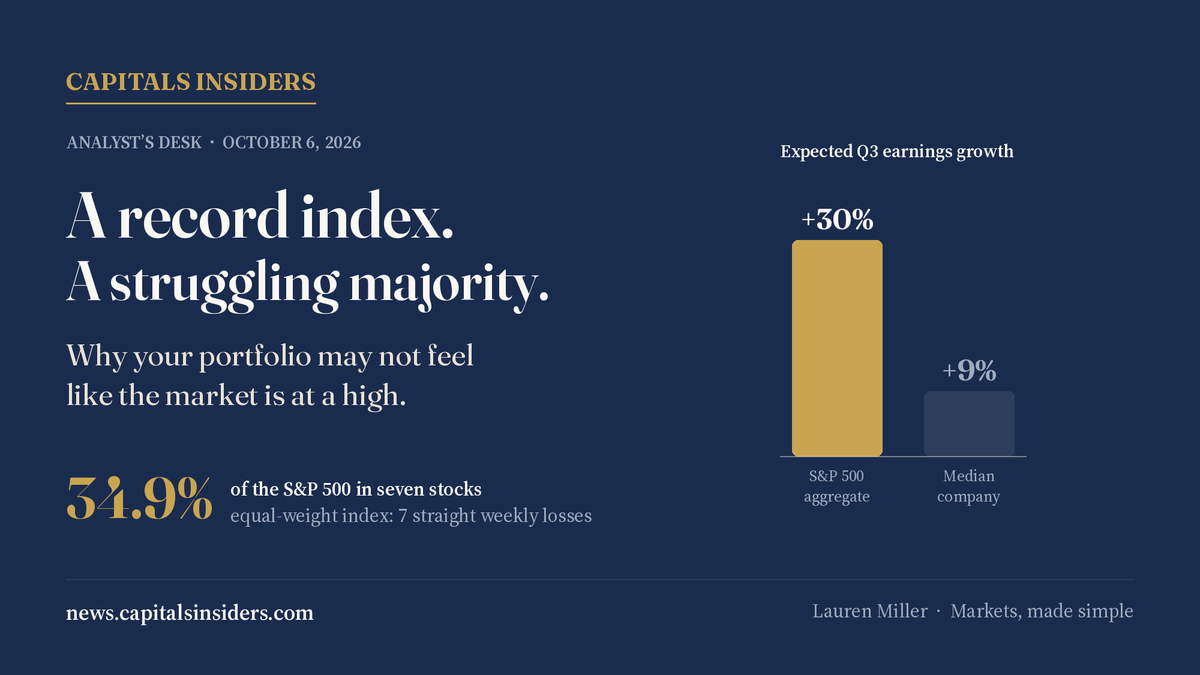
📊 Analyst's Desk A record index, a struggling majority: the market’s 30% vs. 9% problem  Start with the two numbers that disagree. The S&P 500 sits near its all-time high. Yet the equal-weight version of the same index, which gives each company the same influence, has just posted its seventh straight weekly loss. That has happened only twice before: in 2002, after the dot-com bust, and in 2022, during the rate-shock bear market. About 52% of S&P 500 stocks were recently trading below their 200-day moving averages while the index sat near a record, a gap last seen in March 2000. WHAT “EQUAL WEIGHT” MEANS The regular S&P 500 weights each company by its market value, so a giant like Nvidia counts for about 7% of the index. The equal-weight version resets every company to about 0.2% each quarter. When the two diverge, it tells you whether a rally is broad or carried by a few very large stocks. The mechanism is concentration. The Magnificent Seven, Apple, Microsoft, Nvidia, Amazon, Alphabet, Meta and Tesla, now make up about 34.9% of the S&P 500 by market value. On Monday alone, Nvidia rose +2.1% to a record close and a market value of $5.76 trillion. When a handful of companies that large move up, the index can rise even while most of its members fall. Here is what the numbers actually say about why. Analysts expect S&P 500 earnings to grow more than 30% from a year earlier in the third quarter, the reporting season that starts next week. But Goldman Sachs estimates growth of about 9% for the median company. The aggregate is pulled up by the AI leaders. The typical business is growing, just at a normal pace, and it is doing so with borrowing costs at two-decade highs.
Monday also showed what this divide looks like in a single deal. France's Schneider Electric agreed to buy U.S. software maker PTC for $22.6 billion in cash, a 42.3% premium; PTC shares jumped about 33%. The buyer is a company that builds equipment for data centers, and the price was considered low because investors have been marking down software companies they fear AI could disrupt. One part of the market is priced as AI's winner; another is priced as its possible casualty. Both things can be simultaneously true: the index is healthy, and most stocks are not. There was one constructive sign on Monday, when the equal-weight index kept pace with the S&P 500 and more stocks rose than fell. For investors, the practical point is what an S&P 500 index fund now holds: roughly a third of it rides on seven companies. A broader rally would need the other 493 to catch up. Neither that nor a reversal at the top is guaranteed. | |
💵 Income Desk: Fixed annuities now pay more than CDs — read the fine print Insurance companies invest premiums mostly in bonds, so the rates on multi-year guaranteed annuities, or MYGAs, rise along with Treasury yields. With yields near two-decade highs, those rates now clearly beat bank CDs: a good MYGA from an A-rated insurer pays roughly 5.30% to 6.00% depending on the term, against about 4.50% for the best five-year CDs and 4.98% for the five-year Treasury note. MYGA, A-rated insurers 5.30%–6.00% depending on term Best five-year bank CD ~4.50% FDIC-insured The higher rate comes with real differences. The very top advertised rates often come from insurers with lower financial-strength ratings. Annuities are backed by the insurer and by state guaranty associations up to limits that vary by state, not by the FDIC. Most contracts charge surrender fees for withdrawing early, and interest is taxed as ordinary income when it is taken out. Whether any of that fits depends on your timeline and your other savings, which is a conversation for a licensed advisor. | |
🧭 Market Sentiment & Calendar S&P 500 advancers vs. decliners, Monday 1.7 : 1 a broader day than recent weeks Equal-weight S&P 500 7 weeks straight weekly losses through Friday One good day does not end a seven-week streak. It is the first thing to watch this week. Today, Oct. 6 Constellation Brands earnings; U.S. trade data. Wed, Oct. 7 Levi Strauss earnings. Thu, Oct. 8 PepsiCo earnings. Fri, Oct. 9 Delta Air Lines earnings; University of Michigan consumer sentiment. Wed, Oct. 14 September CPI and the 2027 Social Security COLA. | |
⚡ Quick Takes Global Watch. Europe's bond stress is centered on France. Investors are weighing budget proposals from Marine Le Pen's party, and Bank of France Governor Moulin warned that the country risks being strangled by interest rates. When the world's long-term borrowing costs rise together, a weak link in Paris can push on yields everywhere, including in Washington. | |
📜 Wisdom of the Street “Diversification is protection against ignorance.” — Warren Buffett An S&P 500 fund still holds about 500 companies. It is simply less diversified than that number suggests, because a third of its weight sits in seven of them. | |
Have a good day. — Lauren Miller, Capitals Insiders |