Why Wall Street cheered the bigger spender
CAPITALS INSIDERS Markets, made simple — every weekday morning · Thursday, October 22, 2026 | |
Good morning. Two of the 10 largest companies in your index fund reported last night, and they made opposite bets. Meta raised its spending plan again. Tesla cut its plan. Investors rewarded the spender and sold the saver. Here is why that is less strange than it sounds. | |
🔔 Opening Bell Stocks: SpaceX's results lifted the market on Wednesday. The Nasdaq rose +1.1% to 26,702.86, the Dow gained +0.7% to 52,856.09 and the S&P 500 added +0.6% to 7,757.17, close to its record from earlier this month. This morning: Futures fell: Nasdaq 100 futures were down about –1.5% and S&P 500 futures about –0.8% as investors weighed the Meta and Tesla reports. Oil: Brent rose about 2% to above $111 a barrel after The New York Times reported that the U.S. and Israel have drawn up plans for possible strikes on Iran after the midterms. President Trump has not approved them. | |
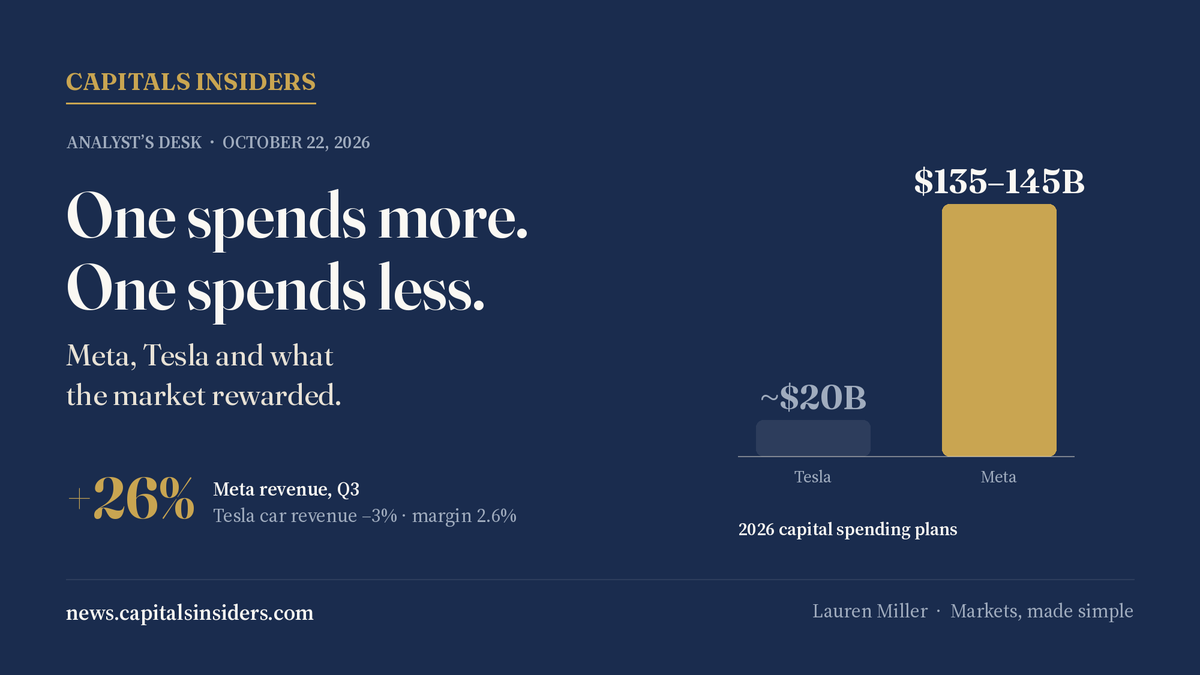
📊 Analyst's Desk Meta spends more, Tesla spends less. The market cheered the spender.  Start with Meta. Revenue rose 26% from a year earlier to $64.6 billion, and the company forecast $73 billion to $76 billion for the fourth quarter, with the top of that range above Wall Street's estimates. Earnings came to $3.83 a share, held down by a $9.89 billion legal charge tied to an agreement with state attorneys general; without it, Meta says, earnings would have been $7.40. Meta raised the bottom of its 2026 spending plan, which now runs from $135 billion to $145 billion, mostly for AI data centers. Its shares rose about 2% after hours. Now Tesla. Revenue of $28.05 billion and adjusted earnings of 48 cents a share both beat estimates. But car sales revenue fell 3% from a year earlier, energy storage revenue fell 16%, and operating profit dropped 56% to $718 million, leaving an operating margin of just 2.6%. Tesla cut its 2026 spending plan to about $20 billion from more than $25 billion, and Elon Musk said the company is aiming for about 5 million vehicles a year by around 2030. The shares fell more than 3% after hours.
WHY INVESTORS CAN CHEER HIGHER SPENDING Spending is judged by what it is expected to earn. Meta’s advertising revenue is growing fast enough that investors are, for now, willing to fund its data centers. Tesla’s car business is shrinking, so a spending cut reads less as discipline and more as a sign of fewer opportunities to invest. The same number can mean opposite things depending on the growth behind it. Two more details matter for shareholders. Meta's board approved a new class of nonvoting shares, which it will hand out as a one-for-one stock dividend in January; Investing.com reports the new class is meant to help Meta raise money for its AI buildout. And Musk confirmed that Tesla and SpaceX have set up independent committees to study a merger, while saying a deal is far from certain. On the call he declined to add more, saying he was "tap dancing through a minefield." Here is what the numbers actually say. Meta and Tesla together are about 4.7% of the S&P 500, as of October 10, so their reports move most index funds whether or not you own the stocks directly. Neither result settles the bigger question hanging over this market, which is whether heavy AI spending will pay off. This morning's futures suggest investors are still unsure. | |
💵 Income Desk: Own Meta? Your share count will double in January Meta's board approved a one-time stock dividend: for every Class A share you own, you will receive one share of a new nonvoting Class C stock, effective January 2027. New Class C shares per Class A share 1 one-time stock dividend Voting rights on Class C shares None effective January 2027 Your total investment should not change. Meta expects the Class A price to adjust as if the stock had split two-for-one, so you will hold twice as many shares at roughly half the price each. The new shares carry no vote, which further concentrates control with Mark Zuckerberg, who already controls the company through a separate Class B stock. Meta has not yet described the tax treatment; when Alphabet distributed nonvoting Class C shares in 2014, shareholders were not taxed on the distribution, and their cost basis was split between the two classes. If you hold Meta in a taxable account, keep the paperwork your broker sends in January. | |
🧭 Market Sentiment & Calendar S&P 500, year to date +13.3% through Wednesday 10-year Treasury yield ~5.06% Thursday morning The S&P 500 is up 1.3% this week despite the AI worries, with all four major indexes higher. Wed, Oct. 28 Fed rate decision. Tue, Nov. 3 Midterm elections. Mon, Dec. 7 Medicare open enrollment ends. January 2027 Meta's Class C stock dividend takes effect. | |
⚡ Quick Takes Super Micro. The AI server maker rose 9.6% on Wednesday after raising its revenue forecast. Meta’s workforce. Meta ended September with 66,775 employees, 15% fewer than a year earlier, even as its revenue grew 26%. | |
📜 Wisdom of the Street “The stock market is filled with individuals who know the price of everything, but the value of nothing.” — Philip Fisher After-hours prices moved in minutes. The value of $140 billion of data centers will take years to show. | |
Have a good day. — Lauren Miller, Capitals Insiders |