What your house is worth now — and who can buy it
CAPITALS INSIDERS Markets, made simple — every weekday morning · Thursday, October 29, 2026 | |
Good morning. The Fed held rates steady yesterday, and the market barely blinked. But one corner of the economy is already feeling every tenth of a point: housing. Signed contracts to buy homes just fell to the lowest level ever recorded. If your house is your largest asset, this is the story to read today. | |
🔔 Opening Bell The Fed: Policymakers held the benchmark rate at 3.75% to 4.00% in a 10-2 vote. Lisa Cook and Beth Hammack dissented in favor of a hike. Chair Kevin Warsh said "politics played no role in the decision." Futures still put the odds of a December hike near 85%. Stocks: The S&P 500 rose +0.3% to 7,743.98, the Nasdaq +0.3% to 26,549.85 and the Dow +0.2% to 52,475.10. The 10-year Treasury yield moved back above 5%. After the bell: Alphabet fell about 10% after saying it expects capital spending to rise significantly in 2027, while Microsoft rose after its cloud business beat estimates. Apple and Amazon report tonight. | |
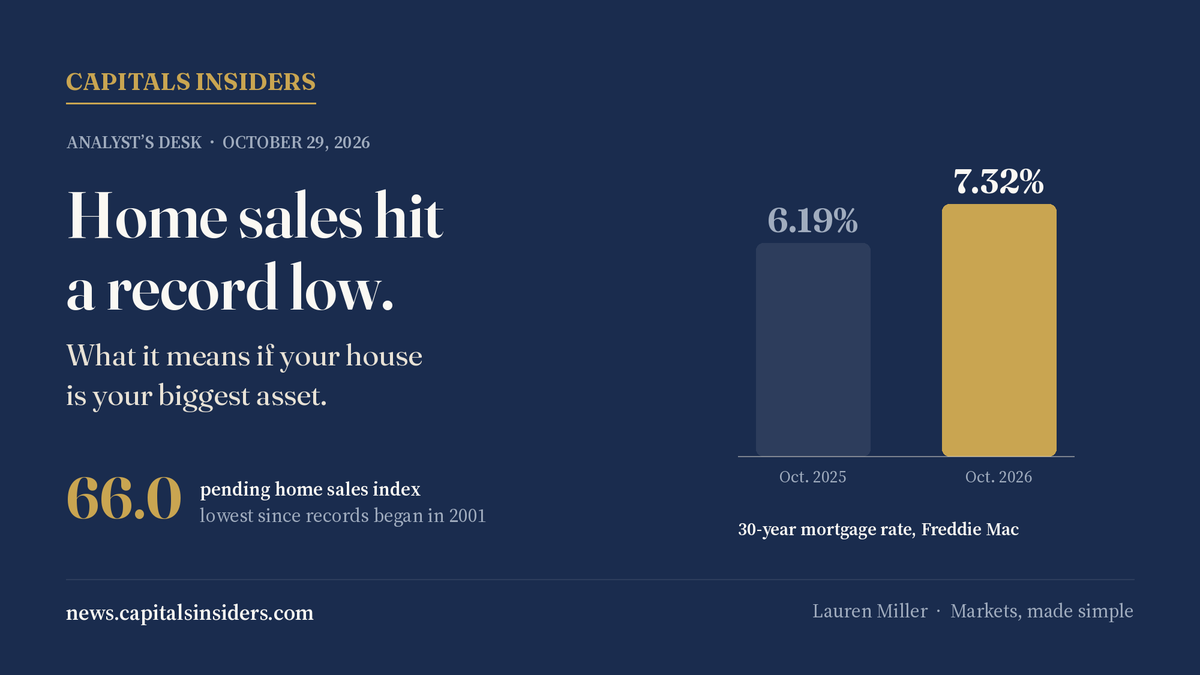
📊 Analyst's Desk Home sales just hit a record low. What it means if you own a house.  Start with the number. The National Association of Realtors' index of pending home sales, which counts contracts signed but not yet closed, fell 7.3% in September to 66.0. That is the lowest reading since the series began in 2001, below anything recorded during the 2008 housing crash. Economists had expected a 0.5% dip. Contracts fell in every region and were down 11.3% from a year earlier. The cause is the cost of borrowing. The average 30-year fixed mortgage rate was 7.32% last week, according to Freddie Mac, after touching 7.40% the week before, the highest in nearly three years. A year ago it was 6.19%. On a $300,000 loan, that difference adds about $225 a month to the payment. Mortgage rates follow the 10-year Treasury yield, which is back above 5% as inflation stays high and the Fed signals more increases ahead.
“Further increases in mortgage rates in recent weeks mean fewer buyers can qualify to purchase a home.” Lawrence Yun, chief economist, National Association of Realtors THE LOCK-IN EFFECT Millions of homeowners borrowed or refinanced when mortgage rates were near 3%. Selling would mean giving up that rate and borrowing again at more than 7%, so many simply stay put. That keeps the supply of homes for sale low, which is why prices have held up even as sales have collapsed. And prices have held. The median existing home sold for $417,500 in September, up 1.3% from a year earlier, and the supply of homes for sale stood at 4.8 months, up from 4.5 a year ago. That is the picture for an owner: your home's value has not fallen, but there are fewer buyers who can afford it at today's rates. For retirees thinking about downsizing or moving closer to family, a sale may take longer and require more flexibility on price. For those who own their home outright, high rates change little day to day, and they are one reason savings accounts and CDs pay more than they have in years. | |
💵 Income Desk: Selling your home? The tax break to know If you sell your main home at a profit, federal law lets you exclude a large part of the gain from income tax, as long as you meet the ownership and use rules. Gain excluded, single filer $250,000 home sale exclusion Gain excluded, married filing jointly $500,000 home sale exclusion To qualify, you generally must have owned the home and lived in it as your main residence for at least two of the five years before the sale, and you can use the exclusion once every two years. The gain is the sale price minus your cost basis, which includes what you paid plus the cost of major improvements, so receipts for a new roof or an addition matter. These limits have not been raised for inflation since 1997, so long-time owners in expensive areas can exceed them. A surviving spouse can generally still use the $500,000 limit if the home is sold within two years of the spouse's death. A tax adviser can confirm how the rules apply to your sale. | |
🧭 Market Sentiment & Calendar Odds of a Fed hike on Dec. 9 ~85% Bloomberg data Rate traders expect by Sept. 2027 ~4.7% about three more hikes Markets believe the Fed is not finished, which keeps long-term rates, and mortgage rates, elevated. Today, 8:30 a.m. Third-quarter GDP; economists expect about 3.2% growth. Today, after close Apple and Amazon report. Today, noon Freddie Mac's weekly mortgage rate survey. Tue, Nov. 3 Midterm elections. Wed, Dec. 9 Next Fed decision. | |
⚡ Quick Takes Boeing. Boeing shares fell about 10.7% on Tuesday after a wider loss and a delay in raising 737 production, a reminder that Dow industrials have their own stories beyond AI. A new Fed calendar. The Fed said one of its eight meetings in 2027 will focus on strategy, with no rate vote and no policy statement. | |
📜 Wisdom of the Street “Home is the place where, when you have to go there, they have to take you in.” — Robert Frost, 1914 For most retirees, home is also the largest asset they own, and this fall it is harder than usual to turn into cash. | |
Have a good day. — Lauren Miller, Capitals Insiders |