What a $2 trillion deficit means for your savings
CAPITALS INSIDERS Markets, made simple — every weekday morning · Tuesday, October 20, 2026 | |
Good morning. The government closed its books for fiscal 2026 on Friday, and one line stood out: Washington spent more on interest than on the entire military. It is not a crisis headline, but it is a slow change that touches your savings, your mortgage and the bond market's mood all at once. | |
🔔 Opening Bell Stocks: Technology bounced back on Monday. The Nasdaq rose +1.1% to 26,430.89 and the S&P 500 added +0.4% to 7,690.73, while the Dow slipped –0.1% to 51,966.03. Chipmakers had fallen 15.7% over the previous eight sessions. This morning: Nasdaq 100 futures fell about –0.7% and S&P 500 futures about –0.3% after a South Korean AI data center company dropped 32% in its trading debut. Housing: Housing starts fell 5.2% in September to an annual pace of 1.22 million, a four-month low, as mortgage rates stay high. Oil: Brent held near $109 a barrel after Iran threatened undersea communication cables in the Strait of Hormuz. | |
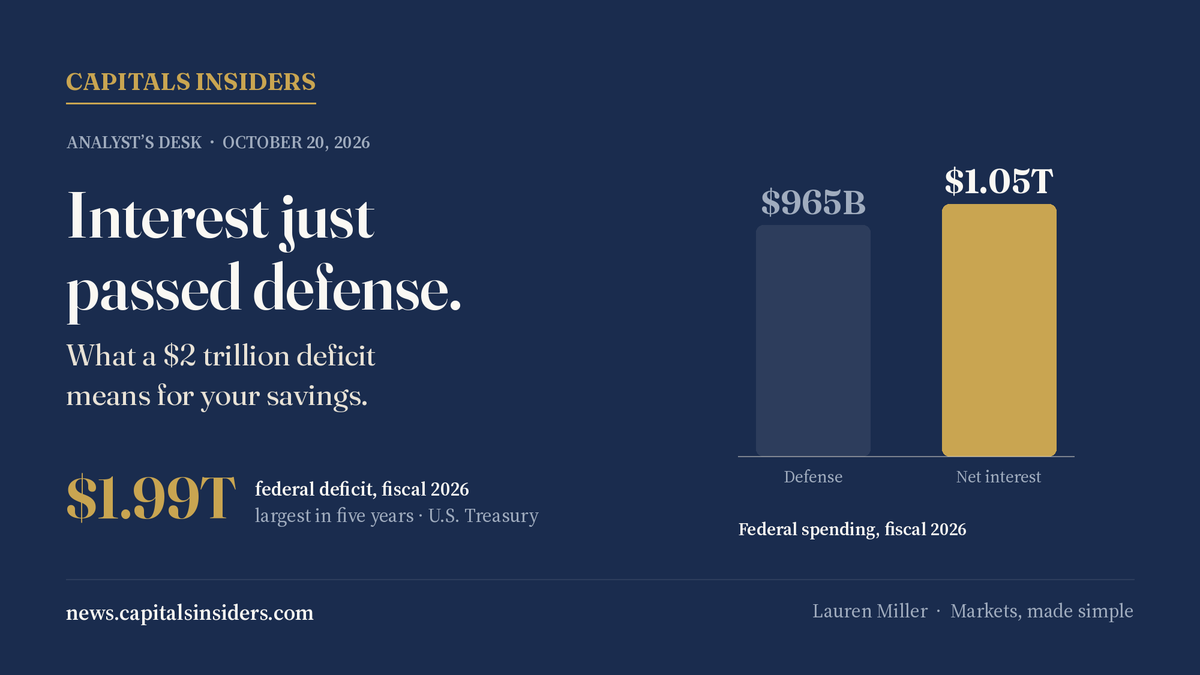
📊 Analyst's Desk Washington now spends more on interest than on defense. Here is what that means for you.  Start with the totals. The federal government ran a $1.99 trillion deficit in the fiscal year that ended September 30, according to the Treasury Department, up $217 billion from the year before and the largest in five years. Revenue rose 3% to a record $5.4 trillion. Spending rose 6% to a record $7.4 trillion. The deficit equaled about 6% of the economy, a level that in the past has usually come during recessions. The fastest-growing large bill is interest. Net interest on the debt reached about $1.05 trillion, up from $971 billion, and passed national defense at $965 billion. Only Social Security, at about $1.7 trillion, and Medicare, at about $1.1 trillion, cost more. Debt held by the public rose by $2 trillion to $32.4 trillion, roughly the size of the entire U.S. economy.
WHY YOU MAY SEE TWO DIFFERENT INTEREST NUMBERS Reports this week cite both $1.36 trillion and about $1.05 trillion. The larger figure counts all interest the Treasury pays, including interest credited to government trust funds such as Social Security’s. The smaller figure, net interest, counts only what is paid to outside lenders, which is the money that actually leaves the budget. The mechanism is simple arithmetic. Much of the debt was borrowed when rates were near zero, and as those bonds mature, the Treasury replaces them at today's rates. The 10-year Treasury yield stands at 5.11% and the 2-year at 4.76%. Revenue also took a hit from an unusual source: customs receipts fell 11% to $173 billion after the Supreme Court struck down tariffs imposed under an emergency-powers law, and the government began issuing refunds. Moody's Analytics chief economist Mark Zandi has warned of a coming "fiscal reckoning." There are two sides to this for a retiree. Every dollar of interest the government pays goes to someone, and many of those someones are savers holding Treasury bills, bonds, money market funds and CDs, who are earning more than they have in many years. The other side is that heavy borrowing keeps long-term rates high, which lifts mortgage costs and makes existing bonds lose value when yields climb. The deficit does not change your Social Security check this year. It does shape the rate environment you invest in, and it will be a central question for whoever controls Congress after November 3. | |
💵 Income Desk: What the Treasury pays you to lend it money The same high rates that strain the budget pay savers. Here is where Treasury yields stood on Tuesday morning. 2-year Treasury yield 4.76% Tuesday morning 10-year Treasury yield 5.11% Tuesday morning Interest on Treasury securities is subject to federal income tax but exempt from state and local income taxes, which can make a meaningful difference for residents of high-tax states when comparing a Treasury to a bank CD. Yields on newly issued Treasuries are fixed for the life of the bond, but the market value of a bond you already own moves in the opposite direction from rates. Treasuries can be bought directly at TreasuryDirect.gov or through a brokerage account, and the choice between short and long maturities depends on when you will need the money. | |
🧭 Market Sentiment & Calendar Odds the Fed holds rates on Oct. 28 82.8% CME FedWatch Bitcoin ~$81,500 –1.6% over 24 hours Monday's rebound was narrow: most stocks outside technology fell, and utilities, real estate and financials lagged. Today, after close Netflix, SpaceX and United Airlines report. Wed, Oct. 21 Tesla and Meta report. Wed, Oct. 28 Fed rate decision. Tue, Nov. 3 Midterm elections. Mon, Dec. 7 Medicare open enrollment ends. | |
⚡ Quick Takes General Motors. GM earned $3.70 a share on an adjusted basis in the third quarter, up from $2.80 a year earlier, on revenue of $50 billion. It narrowed its full-year profit forecast to $12.75–$13.75 a share and approved a new $20 billion share buyback after finishing a $6 billion program. AI & Tech Watch. The AI rebound stalled overnight after Elice, a South Korean data center provider, fell 32% on its first day of trading in Seoul. Investors are separating the companies that sell AI capacity from the ones that must borrow to build it. | |
📜 Wisdom of the Street “I place economy among the first and most important virtues, and public debt as the greatest of dangers to be feared.” — Thomas Jefferson, 1816 Two centuries later, the interest bill is larger than the defense budget. | |
Have a good day. — Lauren Miller, Capitals Insiders |