The economy added 29,000 jobs. Wall Street cheered anyway
CAPITALS INSIDERS Markets, made simple — every weekday morning · Friday, October 2, 2026 | |
Good morning. The September jobs report landed at 8:30 this morning, and it was far weaker than expected. Markets cheered anyway. Here is why both reactions make sense, and why retirees are part of the story. | |
🔔 Opening Bell Stocks: The S&P 500 rose +0.19% to 7,666.45 on Thursday, breaking a three-day losing streak. The Dow added +0.04% to 50,926.56 and the Nasdaq +0.04% to 26,871.60. Bonds: The 10-year and 30-year Treasury yields again touched their highest levels in more than 20 years on Thursday morning before easing in the afternoon. Chips: Micron rose +3.03% to $1,097.39, a day after its record quarter. Today: Tesla's third-quarter deliveries are due, with analysts expecting about 462,000 vehicles. | |
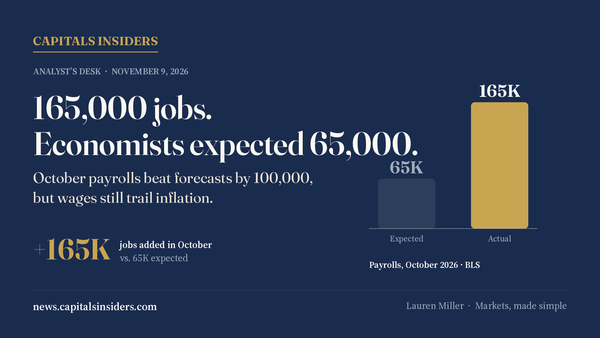
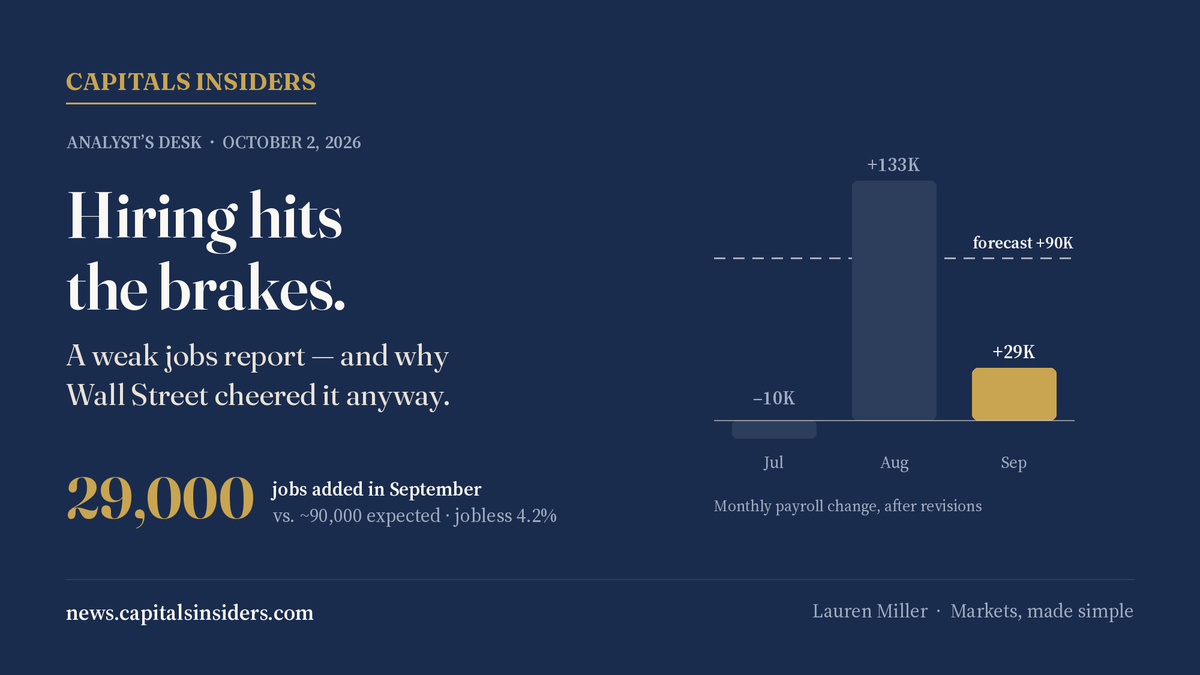
📊 Analyst's Desk 29,000 jobs: a weak number in a changed labor market  Start with the number that matters most. The U.S. economy added 29,000 jobs in September, according to the Bureau of Labor Statistics. Economists had expected about 90,000. The unemployment rate rose to 4.2% from 4.1%, and 7.1 million people were unemployed. The revisions were as important as the headline: August was cut to 133,000 from 162,000, and July turned from a small gain into a loss of 10,000. In total, the past two months now show 60,000 fewer jobs than previously reported.
The market's reaction was rational, in one sense. Stocks rose and the dollar fell. Two weeks ago, Fed Chair Kevin Warsh said the labor side of the Fed's mandate was in good shape, which helped justify the September rate hike. A soft report makes another hike this month less likely, and with the bond market already pushing borrowing costs to two-decade highs, traders read weaker hiring as a reason for the Fed to stay put on October 28. WHY 29,000 IS NOT 2009 The economy now needs far fewer new jobs each month to keep unemployment stable than it did a decade ago. Two forces shrink the supply of workers: tighter immigration and a steady wave of retirements. The Fed and other forecasters have cut their estimates of this “breakeven” pace sharply. That is why the unemployment rate is still low at 4.2% despite weak hiring, and why first-time jobless claims have hovered near 57-year lows. Many of the people who left the labor force in recent years are reading this newsletter. There are reasons for caution in both directions. Payroll counts tend to come in soft when Labor Day falls late in the month, as it did this year, so September may be revised up. But the pattern of the past three months, a loss, a gain and then a near-stall, points to an economy where companies are hiring cautiously even as they avoid layoffs. Both things can be simultaneously true: the labor market is still tight, and it is no longer getting tighter. Neither a slowdown nor a rebound is confirmed by one report. | |
💵 Income Desk: What a Fed on hold means for your cash If the Fed pauses in October, the yields on money-market funds and new short-term CDs will tend to stay near current levels rather than rise further. Those rates follow the Fed's benchmark closely. Longer CDs and Treasury notes follow a different signal: the bond market, where yields remain near their highest levels since the 2000s. Fed funds target range 3.75%–4.00% set at the September 16 meeting Next Fed decision Oct. 28 second day of the FOMC meeting The trade-off for savers is the familiar one, with sharper edges this year. A longer term locks in today's yield if rates later fall, but gives up the chance to earn more if the Fed hikes again. A shorter term keeps that flexibility, at the cost of reinvestment risk if rates drop. Which matters more depends on when you will need the money, which is a question for your own plan, not for the jobs report. | |
🧭 Market Sentiment & Calendar U.S. dollar index, after the report 101.80 –0.23% on the day Dow, third quarter –2.7% while the Nasdaq gained +2.5% The quarter rewarded growth and punished the blue chips. The jobs report gave both a reason to hope the Fed waits. Today, Oct. 2 Tesla third-quarter deliveries. Wed, Oct. 14 September CPI and the 2027 Social Security COLA. Oct. 27–28 FOMC meeting. Fri, Nov. 6 October jobs report. | |
⚡ Quick Takes AI & Tech Watch. Accenture jumped +15.8% to $212.30 on Thursday after its quarterly results eased fears that AI would hollow out the consulting business. The company booked a record 141 client deals worth $100 million or more, and other IT-services firms rallied with it. For now, companies are paying consultants to help them adopt AI rather than replacing them with it. | |
📜 Wisdom of the Street “The stock market has predicted nine of the last five recessions.” — Paul Samuelson One weak jobs report is a data point, not a forecast. July was negative, August was strong, and September will be revised. | |
Have a good weekend. — Lauren Miller, Capitals Insiders |