The $54 billion quarter: inside Micron's AI memory boom
CAPITALS INSIDERS Markets, made simple — every weekday morning · Thursday, October 1, 2026 | |
Good morning, and welcome to the fourth quarter. It opens with one of the most remarkable earnings reports of the AI era: a company that sells memory chips, a business long known for booms and busts, just reported a quarter nearly five times larger than a year ago. Futures are higher because of it. | |
🔔 Opening Bell Stocks: The Dow fell –0.86% to 50,906.05 on Wednesday, the S&P 500 lost –0.25% to 7,651.54 and the Nasdaq rose +0.24% to 26,861.06. This morning, Nasdaq 100 futures were up about +1% and S&P 500 futures about +0.6%. Asia: Japan's Nikkei 225 jumped +3.1% on chip and AI stocks. Hong Kong and mainland China are closed for National Day. Bonds: The 10-year Treasury yield stood near 5.28%, and Treasury yields rose again this morning to their highest levels in more than two decades. Oil: Crude rose this morning after Chinese refiners banned October fuel exports. | |
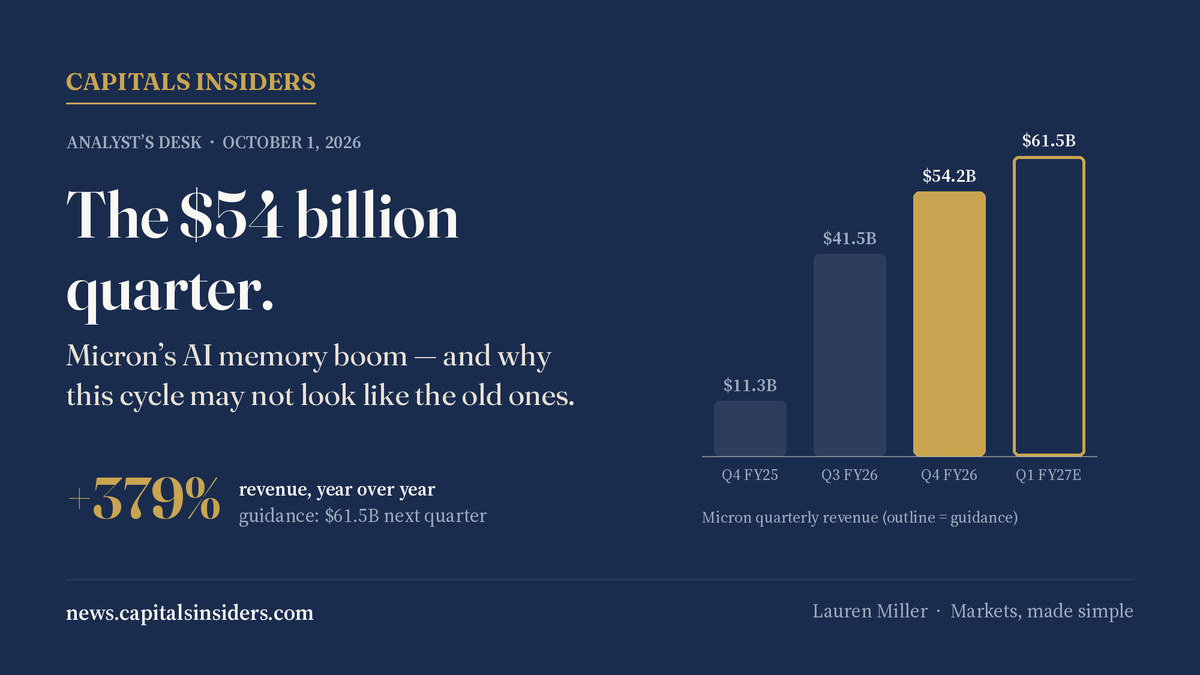
📊 Analyst's Desk Micron’s $54 billion quarter — when memory stops behaving like a commodity  Start with the number that matters most. Micron reported fiscal fourth-quarter revenue of $54.23 billion on Wednesday, against $11.32 billion a year earlier, an increase of 379%. Analysts had expected $50.45 billion. Adjusted earnings came in at $33.42 a share versus a $31.16 forecast. For the full fiscal year, revenue reached a record $133.2 billion, up 256%. In fairness to the competition, the quarter was 14 weeks long instead of 13. The extra week helped. It did not account for the other $42 billion. The guidance was the bigger surprise. Micron expects about $61.5 billion of revenue and $38.15 of adjusted earnings per share in the current quarter, against analyst expectations of $57 billion and $35.40. Management said memory supply will be even tighter in fiscal 2027 and 2028 than this year, and that demand for high-bandwidth memory, the stacked chips that sit next to AI processors, will grow faster than conventional memory through 2028. Micron is the only U.S.-based maker of that memory and is working with Nvidia on the industry's first custom version.
THE OLD MEMORY CYCLE For decades, memory chips were the most cyclical corner of technology. When prices rose, makers built new factories; when those factories came online at once, supply flooded the market and prices collapsed. Investors learned to sell memory stocks when profits looked best. The bull case today rests on one change: customers are now signing multi-year volume commitments, which makes demand more visible than the old spot-market model ever allowed. Here is what the numbers actually say about the shift. Micron's operating margin reached 82.3% in the quarter, and its gross margin 87%, levels normally associated with software rather than factories. Cloud memory and core data-center customers together made up about 63% of revenue, so the business now rises and falls with AI spending rather than with sales of phones and laptops. The effect reaches well beyond one company: South Korea, home to the two other giant memory makers, reported September exports up 83.5% from a year earlier. Both things can be simultaneously true. The fundamentals are extraordinary, and much of that is already in the price: Micron shares are up more than 500% over the past year, and the stock barely moved after the report. The structural argument holds as long as AI customers keep building. Neither the length of this cycle nor the timing of its turn is guaranteed. | |
💵 Income Desk: A softer inflation number that does not reach your check The Fed's preferred inflation gauge came in softer than expected on Wednesday. Core PCE rose 0.2% in August against a 0.3% forecast, and the annual rate eased to 3.0%. Part of the decline came from methodological changes in how the index is calculated, which is why markets treated it with caution. Core PCE, year over year 3.0% August; 0.2% month over month Odds of an October Fed hike ~38% down from about 73% a week ago For retirees, the mechanism has a twist. PCE is what the Fed watches, but Social Security's cost-of-living adjustment is based on a different index, CPI-W. A softer PCE reading can lower the odds of another rate hike, which matters for CD and money-market yields. It does not change the 2027 COLA. That number depends on September's consumer price data, listed in the calendar below. | |
🧭 Market Sentiment & Calendar VIX, Wednesday close 16.34 +1.9% on the day Speculators' net short, S&P 500 futures 355,121 contracts; +66,665 in the latest week Large speculators are betting more heavily against the index even as chip stocks rally. That tension is worth watching. Today, Oct. 1 Freddie Mac weekly mortgage rate survey. Fri, Oct. 2 September jobs report, 8:30 a.m. ET. Wed, Oct. 14 September CPI and the 2027 Social Security COLA. Oct. 27–28 FOMC meeting. | |
⚡ Quick Takes AI & Tech Watch. Micron was not the only chip story. Synopsys, whose software is used to design chips, rose +4.8% on Wednesday, the Nasdaq's biggest gainer. Alphabet began rolling out its Gemini 4 Argon model, and Google is preparing to launch AI chips into orbit, a reminder of how far the industry is now reaching for power and space. | |
📜 Wisdom of the Street “Know what you own, and know why you own it.” — Peter Lynch A memory company that earns most of its revenue from data centers is a different business from the one many investors remember. The ticker is the same. | |
Have a good day. — Lauren Miller, Capitals Insiders |