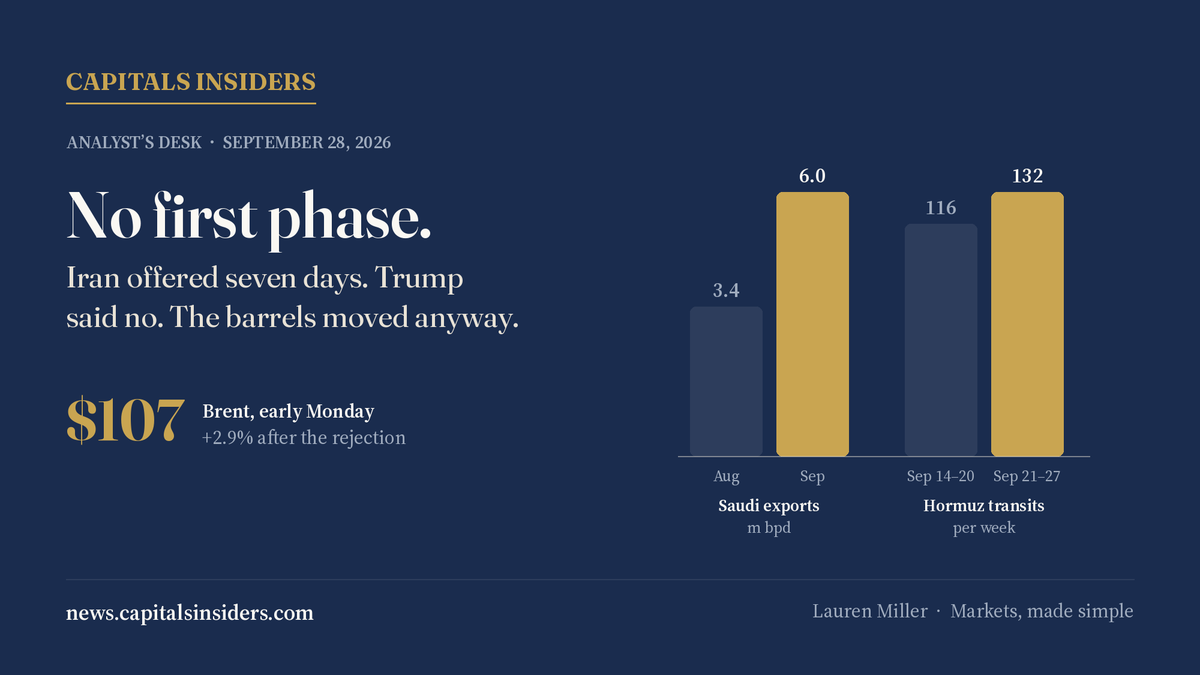
Iran offered seven days. Trump said no. Oil is at $107.
CAPITALS INSIDERS Markets, made simple — every weekday morning · Monday, September 28, 2026 | |
Good morning. On Friday I said this issue would tell you whether the Hormuz talks produced a first phase. They did not. Iran put a seven-day plan on the table, and President Trump rejected it on Saturday. Oil is higher this morning. Let’s go in order. | |
🔔 Opening Bell Stocks: The S&P 500 rose +0.51% on Friday to 7,743.41, finishing the week +1.21% and within 0.7% of its record. The Dow gained +0.93% to 51,828.62, snapping a three-week losing streak, and the Nasdaq added +0.48% to 27,068.72. Bonds: The 10-year Treasury yield closed Friday at 5.184%, its highest close since July 6, 2007, up from 4.998% a week earlier. Oil: Brent jumped +2.89% to $107.34 in early Monday trading after Trump's rejection of the Iranian plan; WTI rose +1.87% to $94.14. | |
📊 Analyst's Desk No first phase — but the barrels found another way  Start with what was offered. On Friday, Iranian Foreign Minister Abbas Araghchi said Tehran had sent Washington, through Qatar, a concrete seven-day plan. If the U.S. lifted its naval blockade, waived sanctions on Iranian oil sales and observed a ceasefire that included Lebanon, Iran would reopen the Strait of Hormuz and resume nuclear talks within a week. On Saturday, Trump told reporters the proposal would not be acceptable. Asked about resuming strikes, he said he is always thinking about it. “The choice now rests with the United States.” Abbas Araghchi, September 25. A day later, Trump: “They made a proposal but I rejected it.” WHY THE ANSWER WAS NO The plan closely mirrors the June memorandum of understanding, which collapsed within days once strikes resumed. It also asks Washington to move first: the blockade and oil sanctions go before the strait reopens. The White House has said it sees no need to negotiate from its current position, and Trump has pointed to the period after the November 3 midterms for a deal. The sequencing problem we described on September 23 has not changed. It has hardened. The door is not fully closed. Araghchi said no rejection had arrived through official channels, and mediators are expected to meet separately with American and Iranian officials on Monday or Tuesday. Trump himself said talks could resume this week. Here is what the numbers actually say. Last Wednesday, I wrote that Saturday's pipeline restart was the more reliable of two signals. It delivered. Saudi Arabia resumed shipments through its East-West pipeline to the Red Sea, with roughly 3.5 million barrels a day flowing again. Saudi crude exports have climbed to about 6 million barrels a day in September, the most since the war began, from 3.4 million in August. Even Hormuz itself is busier: 132 vessel transits last week, up from 116.
Both things can be simultaneously true: physical supply is improving, and oil is still rising. The mechanism is that the price now carries two premiums. The supply premium is shrinking as barrels reroute around the strait. The political premium is growing, because the rejection pushes any deal toward November or later. Cornelia Meyer, chief executive of Meyer Resources, said energy markets are pricing a “clear and present danger” of renewed hostilities after the midterms. For investors, the price of oil this autumn is less a question of Hormuz today than of Washington's calendar. Neither outcome is guaranteed. | |
💵 Income Desk: Your third-quarter statement, decoded The quarter ends Wednesday, and many retirees will open statements that seem to disagree with themselves. Stocks are up solidly for the year: the Nasdaq has gained +16.5% through Friday. Bonds tell a different story. The 10-year yield rose more than 0.4 percentage points in September alone, and the two-year yield rose more than 0.5 points, which pushes down the price of bonds already held. S&P 500, year to date +13.1% through September 25 Months since 1990 with a 2-year yield jump of 0.5 pt+ 16 including September; later stock returns were mixed The mechanism matters more than either number. When stocks rise and bonds fall at the same time, a portfolio drifts away from the mix it started with. A retiree who began the year with 60% in stocks and 40% in bonds now holds more stock, and more stock risk, than planned, without having made a single trade. The quarter-end statement is the easiest place to see that drift. What to do about it depends on each person's plan, which is a conversation for a licensed advisor. | |
🧭 Market Sentiment & Calendar VIX, Friday close 14.85 –5.2% on the day Korea's Kospi, Monday –2.70% Japan's Nikkei –0.73% U.S. stocks ended the week calm. Asia opened the new one less so, with oil moving higher. Mon–Tue Mediators meet separately with U.S. and Iranian officials. Wed, Sept. 30 Third quarter ends. Fri, Oct. 2 September jobs report, 8:30 a.m. ET. Oct. 27–28 FOMC meeting. Tue, Nov. 3 Midterm elections. | |
⚡ Quick Takes AI & Tech Watch. Meta gained roughly 12% last week on enthusiasm for its Muse AI agent and a run of new hardware, bringing the company close to a $2 trillion market value, even after a –3.3% dip on Friday. The market is rewarding the company that turned AI into something people use every day, not only the companies that sell the chips behind it. | |
📜 Wisdom of the Street “The four most dangerous words in investing are: ‘this time it’s different.’” — Sir John Templeton Iran's seven-day plan looked a lot like June's. So did Washington's answer. | |
Tomorrow: what the mediators bring back from both sides, and whether oil keeps its political premium. Have a good day. — Lauren Miller, Capitals Insiders |