Gold is 26% off its record — in the middle of a war. Here's why.
CAPITALS INSIDERS Markets, made simple — every weekday morning · Monday, October 5, 2026 | |
Good morning. There is a war in the Middle East, inflation is above 3% and the Fed has been raising rates. By the old rulebook, gold should be soaring. Instead, it sits about a quarter below its January record. Today’s issue explains why, and what it means for anyone who owns it. | |
🔔 Opening Bell Stocks: The S&P 500 gained +0.7% on Friday to 7,722.72 and the Dow rose +0.5% to 51,176.96 after the soft jobs report trimmed bets on another Fed hike. For the week, the S&P 500 slipped –0.3%, the Nasdaq gained +0.5% and the Dow fell –1.3%. This morning: Stocks opened near flat as Treasury yields stayed high ahead of this week's release of the Fed's meeting minutes. Deals: C.H. Robinson agreed to buy freight broker RXO in a cash-and-stock deal valued at about $5.8 billion. | |
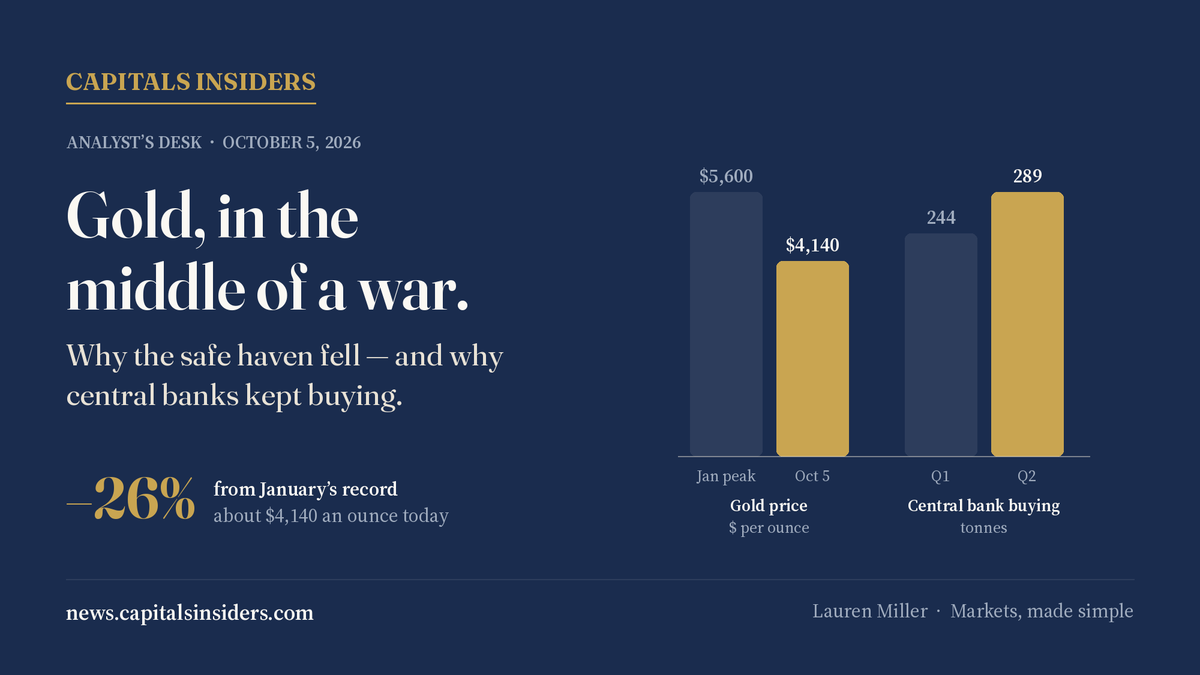
📊 Analyst's Desk Why gold is down 26% from its record in the middle of a war  Start with the number that matters most. Gold reached an all-time high of about $5,600 an ounce in late January. This morning, futures traded near $4,190 and spot gold near $4,140, roughly 26% below that peak. Over the past month alone, gold has fallen about 6%. It is still up about 4.4% from a year ago, so long-term holders are ahead. Anyone who bought this winter is not. The mechanism is interest rates. Gold pays no interest and no dividend; its return comes only from its price. That makes its biggest competitor the safest income available, and this autumn that competitor got far more attractive. The Fed raised rates in September, and the 10-year Treasury yield climbed to its highest level since 2007. When a government bond pays more than 5%, holding a metal that pays nothing has a real cost. Investors measure that cost in real yields, the return on bonds after inflation, and real yields have risen sharply. “It doesn’t do anything but sit there and look at you.” Warren Buffett on gold, 2009. At 5% bond yields, sitting there costs more. Here is where it gets structurally interesting. The largest buyers did not sell. According to the World Gold Council, central banks bought a net 244 tonnes in the first quarter and a record 288.9 tonnes in the second, up 62% from a year earlier, even as the price fell 14% during that quarter. Their reasons are not about next month's yield: diversifying reserves away from the dollar and holding an asset no other government can freeze.
THE MINERS FELL HARDER Gold mining stocks have fallen two to five times as much as the metal this year. The reason is leverage: a miner’s costs stay roughly fixed while its revenue moves with the gold price, so a 26% drop in gold can wipe out a much larger share of profit. Higher energy prices, a major cost for mines, have made the squeeze worse. Read together, these facts describe two different buyers. Financial investors sell gold when bonds pay well. Central banks buy it for reasons that have little to do with yields. The price this year has followed the first group, while the second has kept a floor under it. What would change the balance is the Fed: a pause or a turn toward cuts would lower the cost of holding gold. Neither is guaranteed, and the minutes due this week will offer the next clue. | |
💵 Income Desk: How gold is taxed — the detail that surprises retirees Physical gold, gold coins and many gold funds that hold the metal directly are treated by the IRS as collectibles. That changes the tax bill on a profit held longer than a year. Top long-term rate on collectibles 28% bullion, coins and many physically backed funds Top long-term rate on stocks 20% most retirees pay 0% or 15% For many retirees, the gap is larger than the top rates suggest: someone whose stock gains fall in the 0% or 15% bracket can still owe more on a gold profit, because collectibles gains are taxed at ordinary income rates up to that 28% cap. Gold also produces no income, so it adds nothing to the cash flow a retirement plan depends on. Gold-mining stocks are taxed like other stocks. The details depend on how each fund is structured and on your own bracket, which is a question for a tax professional. | |
🧭 Market Sentiment & Calendar VIX, Friday close 15.31 –6.6% on the day Nasdaq new 52-week lows vs. highs 224 vs. 57 Friday The index is near records. Underneath, far more stocks are making new lows than new highs. This week Fed meeting minutes; earnings from PepsiCo, Delta Air Lines, Constellation Brands and Levi Strauss. Wed, Oct. 14 September CPI and the 2027 Social Security COLA. Thu, Oct. 15 Medicare open enrollment begins. Oct. 27–28 FOMC meeting. | |
⚡ Quick Takes AI & Tech Watch. Intel slid in premarket trading on reports that Elon Musk may turn to Taiwan's TSMC, rather than Intel's contract-manufacturing business, for a new chip venture. Cerebras rose after OpenAI's Sam Altman called the AI chipmaker a close partner. In the AI chip race, one sentence from the right customer still moves a stock. | |
📜 Wisdom of the Street “In truth, the gold standard is already a barbarous relic.” — John Maynard Keynes, 1923 A century later, the world's central banks are buying it at a record pace. Gold is insurance, not income, and its value this year depends on which of those two jobs you bought it to do. | |
Have a good day. — Lauren Miller, Capitals Insiders |