Congress changes hands. What it means for your money.
CAPITALS INSIDERS Markets, made simple — every weekday morning · Wednesday, November 4, 2026 | |
Good morning. Democrats won control of both the House and the Senate in yesterday's midterm elections, according to projections by major news organizations. Stock futures swung overnight and are higher this morning. Here is what changes for investors, what does not, and why the first reaction matters less than it feels. | |
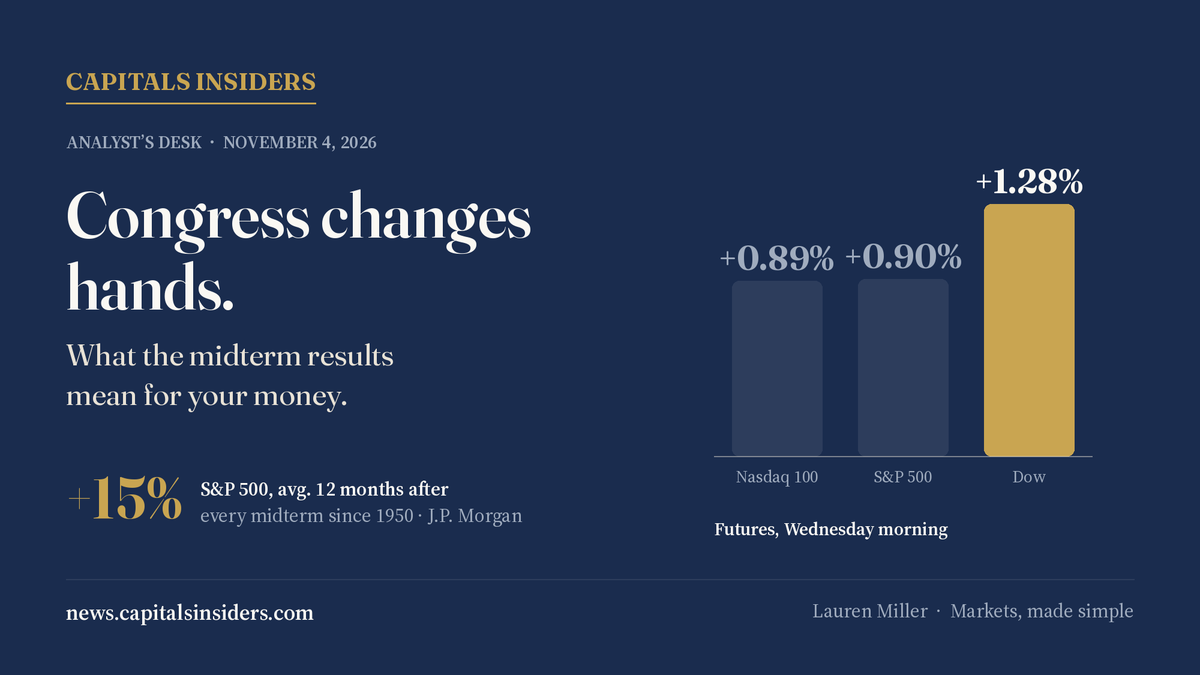
🔔 Opening Bell Tuesday: The Nasdaq rose +0.83% and the S&P 500 +0.36%, ending a three-day losing streak, while the Dow slipped –0.38% as Apple fell nearly 2% after its results. This morning: After falling overnight, futures turned higher: Dow futures were up about +1.3% and S&P 500 and Nasdaq 100 futures about +0.9%. AMD rose about 6% before the open after strong results. Oil and bonds: Brent crude slipped to about $103 a barrel and the 10-year Treasury yield eased toward 4.92%. | |
📊 Analyst's Desk Congress changes hands. What it means for your money.  Start with the result. Going into the vote, Republicans held 218 House seats to 214 for Democrats, and 53 Senate seats to 47 for Democrats and the two independents who vote with them. Democrats needed a net gain of four seats in each chamber. Major news organizations projected overnight that they reached control of both; some individual races are still being counted. The new Congress takes office in January. The market's first reaction was mixed. Futures fell late Tuesday as results came in, then recovered and were higher by early Wednesday. Health care and renewable energy shares gained in early trading on expectations of policy shifts, while defense stocks fell. AI and chip stocks were under some pressure on a separate concern: in Texas, the newly elected governor, Gina Hinojosa, has proposed a pause on new data center projects, and voters in a number of cities weighed local limits on them.
WHAT DIVIDED GOVERNMENT USUALLY MEANS With the White House and Congress held by different parties, major legislation generally needs agreement from both sides, so sweeping changes to taxes or spending become harder to pass. Many investors have historically welcomed that predictability. Policies set by the executive branch, such as tariffs and many regulations, are less directly affected. Here is what the numbers actually say. As we wrote on Monday, the S&P 500 has been higher 12 months after every midterm election since 1950, with an average gain of about 15%, under both parties. That record is a small sample, and this year's market faces its own pressures: expensive valuations, a Fed still leaning toward higher rates, and doubts about AI spending. Those forces are likely to matter more than the election over the coming year. The practical point is simple. Election results rarely justify large portfolio changes on their own, and early moves in futures often fade once the full picture settles. The next tests come quickly: the Treasury's borrowing plans today and the October jobs report on Friday. | |
💵 Income Desk: Year-end tax-loss harvesting, explained After October's technology selloff, some investors hold positions worth less than they paid. Selling them before December 31 can create a loss that reduces taxes, within limits. Losses deductible against ordinary income $3,000 per year; $1,500 if married filing separately Wash-sale window 30 days before or after the sale Capital losses first offset capital gains in the same year, then up to $3,000 of other income; any remainder carries forward to future years. The wash-sale rule disallows the loss if you buy the same or a substantially identical security within 30 days before or after the sale, including in an IRA. Harvesting only applies in taxable accounts, not in IRAs or 401(k)s. A tax adviser can say whether it makes sense for your situation. | |
🧭 Market Sentiment & Calendar AMD before the open ~+6% data center sales nearly doubled 10-year Treasury yield ~4.92% Wednesday morning Health care and renewable energy led early gains after the vote; defense lagged. Today, Nov. 4 Treasury borrowing announcement; Uber, Qualcomm, McDonald's and Arm report. Fri, Nov. 6 October jobs report. Wed, Dec. 9 Next Fed decision. Thu, Dec. 31 Last day for 2026 tax-loss sales and required minimum distributions. January 2027 New Congress takes office. | |
⚡ Quick Takes Apple. Apple shares fell about 2% on Tuesday after the company forecast lower profit margins because of rising memory chip costs, despite record September-quarter sales. | |
📜 Wisdom of the Street “The four most dangerous words in investing are: ‘This time it’s different.’” — Sir John Templeton Every election feels like a turning point the morning after. For markets, it has usually been one input among many. | |
Have a good day. — Lauren Miller, Capitals Insiders |