Brent at $99: what the Iran talks changed — and what they didn't
CAPITALS INSIDERS Markets, made simple — every weekday morning · Wednesday, September 23, 2026 | |
Good morning. On Tuesday, Washington and Tehran spent three hours working through the same room of mediators and came away with two versions of what happened. Oil fell, stocks barely noticed, and the more useful date for the market is now Saturday. Here is why. | |
🔔 Opening Bell Stocks: The Nasdaq rose +0.5% to a record 27,244.28, while the S&P 500 finished essentially flat at 7,764.64, sitting 0.4% below its August all-time high; the Dow fell –0.4% to 51,863.69. It was the Nasdaq's second record close in a row. The Fed backdrop: On September 16, the FOMC voted 12-0 to raise its benchmark rate by 25 basis points to 3.75%–4%, its first increase since 2023. The median official expects one more hike this year. Xi in Washington: China's president begins a state visit today that runs through September 25. Iran is on the agenda for a specific reason: China is Tehran's biggest oil customer. Insurance: Allstate fell –5.26% after disclosing an estimated $748 million in catastrophe losses for August alone. | |
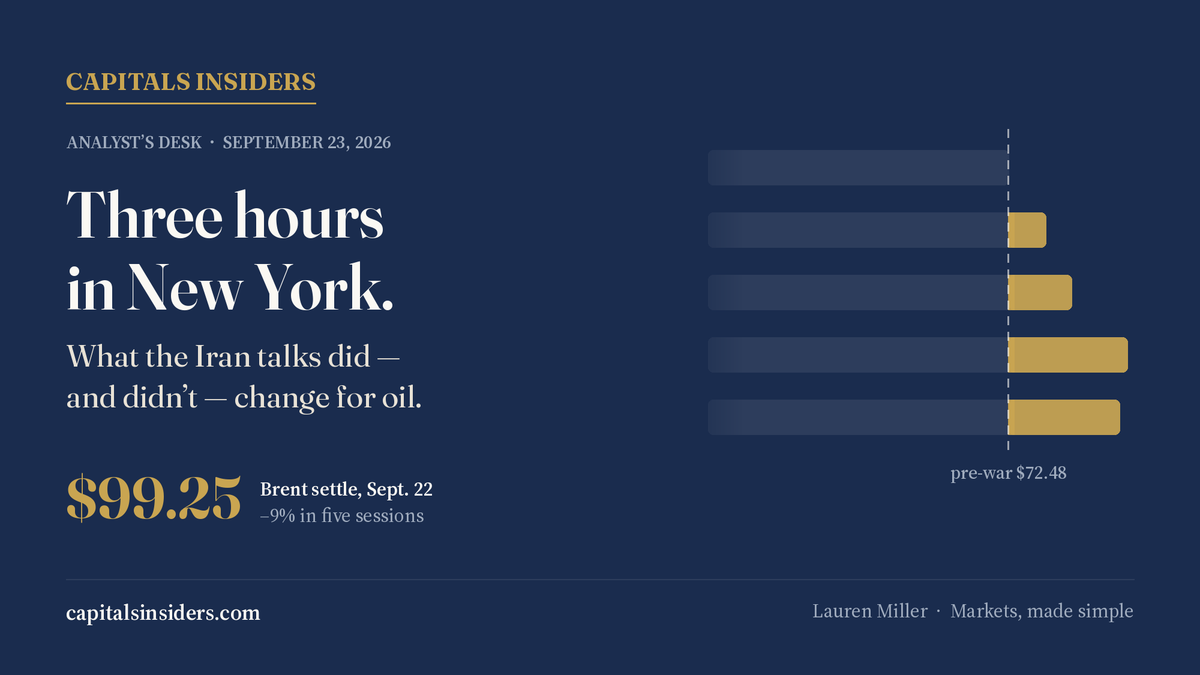
📊 Analyst's Desk Three hours in New York — what the Iran talks did and did not change  Start with what actually happened, because the two sides describe it differently. President Trump said Steve Witkoff and Jared Kushner held a three-hour meeting with Iran's delegation on the sidelines of the UN General Assembly. He called it "very good" and "very productive" and said the next round would come "in the very near future." Witkoff's own account was narrower: the talks ran through mediators who moved between the two delegations throughout the day. Iranian state media confirmed a meeting between Foreign Minister Abbas Araghchi and Witkoff after weeks without direct contact. A mediated round is a probe. A direct one is a negotiation. The distinction matters. “Not the highest level, but it’s something.” President Trump on Tuesday’s talks, September 22 Tehran used the room to set terms: an end to the U.S. naval blockade, the release of frozen assets and an end to the war on all fronts. A senior Iranian official said that if Washington moved toward ending the blockade, Iran would be prepared to reopen the Strait of Hormuz within seven days. Trump, for his part, told the UN he expects a deal after the midterm elections. Both sides want a deal, and neither wants to move first. That sequencing problem has sunk an agreement before: a June 17 memorandum to open Hormuz collapsed quickly once fighting broke out over which routes ships could use. WHY HORMUZ MATTERS Before the war, roughly one-fifth of the world’s daily oil consumption passed through this single strait — about 20 million barrels a day in 2024, by EIA estimates. The International Energy Agency has called its near-closure the largest supply disruption in the history of the global oil market. That is why a date for reopening moves prices more than any statement about talks. Here is what the numbers actually say. Brent settled at $99.25 on Tuesday, after falling nearly 9% over five sessions. Last week it traded near $110; before the war it cost roughly $72. Diplomacy explains only part of the slide. Saudi Arabia is aiming for a meaningful restart of its East-West pipeline to the Red Sea by Saturday. The pipeline is a physical fact with a date attached. The talks, so far, are a promise with a date to be announced.
Why this matters beyond the energy sector: in August, headline CPI rose 3.4% year over year, and gasoline alone (+3.9% month over month) accounted for more than a third of the monthly increase. On September 22, the AAA national average stood at $4.475 a gallon. Retail gasoline follows crude with a lag of several weeks, so this week's slide in oil has not reached drivers yet. The mechanism is clear: oil feeds inflation, inflation drove the Fed's hike, and the Fed has signaled one more. For investors, then, the question is not whether a second meeting happens. It is who moves first: the blockade or Hormuz. Neither outcome is guaranteed. Until one of them is, Saturday's pipeline restart is the more reliable of the two signals. | |
💵 Income Desk: The war shows up in your 2027 check Here is one place the war reaches retirees directly. Social Security’s cost-of-living adjustment is set by the average of the CPI-W index for July, August and September, and energy has kept that index elevated through the quarter. After the August report, The Senior Citizens League estimates the 2027 COLA at 3.5%, up from 2.8% this year; AARP projects 3.6%. What that means in dollars: Average retired-worker benefit +$73 / month on $2,085.98 at a 3.5% COLA, about $876 a year Medicare Part B, 2027 $209.50 / month projected standard premium Two caveats. For most retirees, the higher Part B premium comes out of the same check, so the net raise is smaller than the headline. And the final input, September CPI, lands on the same day the Social Security Administration announces the number. This month’s gasoline prices are part of that input; last week’s slide in oil mostly is not. | |
🧭 Market Sentiment & Calendar VIX, Tuesday close 14.58 +2.6% on the day 10-year Treasury yield 4.93% eased with oil That is a calm reading for a market with a war in the background. Thu, Sept. 24 Trump–Xi summit at the White House; state dinner with technology CEOs. Weekly jobless claims. Sat, Sept. 26 Target date for the Saudi East-West pipeline restart. Wed, Oct. 14 September CPI and the 2027 Social Security COLA announcement. Oct. 27–28 FOMC meeting. Tue, Nov. 3 Midterm elections — the timeline Trump has named for an Iran deal. | |
⚡ Quick Takes Digital Assets. Bitcoin traded at $86,644 late Tuesday. It moved above its 50-week moving average for the first time in 45 weeks, yet it remains about 31% below its all-time high. The rally forced the liquidation of $648 million in short positions over 24 hours. Strategy added 950 BTC between September 14 and 20, bringing its holdings to 846,000. AI & Tech Watch. It is not every day that an app that books dinner reservations moves the semiconductor sector. Meta launched its Muse agent on September 8, and it has since reached No. 1 among free apps on the U.S. App Store. On Monday, AMD rose about +10% to close above $1 trillion in market value, the 14th U.S. company to cross that line; Intel rose +12%. Meta itself gained +11.4%, its best session since April 2025. The structural argument holds because agents consume general-purpose CPU compute, not only GPUs. AMD CEO Lisa Su had already called agentic workloads the largest piece of the company's addressable market. | |
📜 Wisdom of the Street “In the short run, the market is a voting machine but in the long run, it is a weighing machine.” — Benjamin Graham Tuesday's talks were a vote. Saturday's barrels will be a weight. | |
Tomorrow, Trump and Xi sit down at the White House, and Iran's largest oil customer will be at the table. I'll have the read on Thursday. Have a good day. — Lauren Miller, Capitals Insiders |